Claude’s New Dreaming Feature
Claude has started to “dream.” Just as people sometimes find clarity after a good night’s sleep, Claude has learned to do the same. Anthropic’s Claude Managed Agents has launched a new feature called Dreaming—
This allows AI to “sleep” during work breaks to reflect, clear memory, summarize patterns, and even self-upgrade.
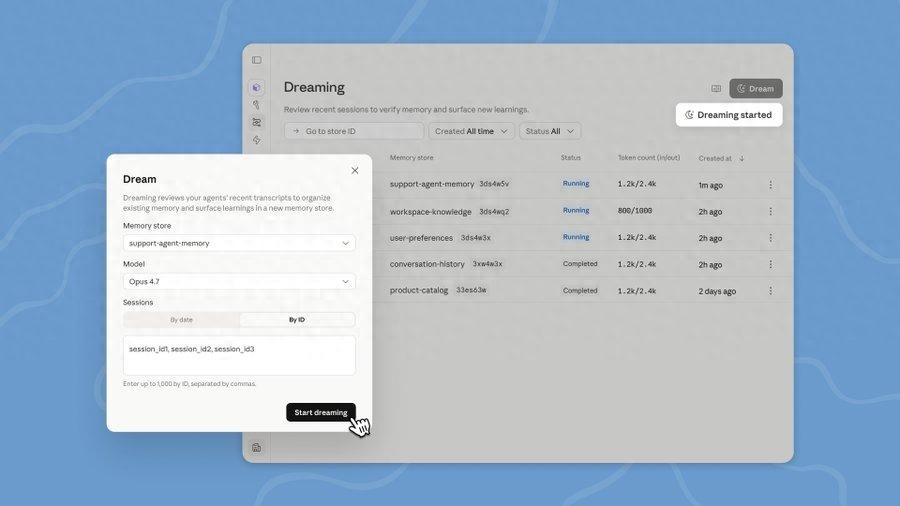
In essence, it is an AI memory organization technique.
The Dreaming function found in the leaked Claude Code has finally been explained.
What Does Claude’s “Dream” Do?
When we chat with AI, each conversation adds content to its memory bank. Over time, this memory bank can become cluttered with redundant, outdated, or irrelevant information, making it difficult for the AI to discern which information to use.
This results in slower and less accurate responses from the AI.
The newly introduced Dreaming feature aims to solve this problem. It runs as an asynchronous task during conversation breaks and involves collective reflection across agents.
Dreaming automatically reads the memory bank and up to 100 historical conversations, performing three main tasks:
- Merging Duplicates and Clearing Noise: It combines similar memory entries and removes redundant information from the memory bank.
- Replacing Old Content and Updating Knowledge: It identifies outdated processes, rules, and preferences, automatically replacing them with the latest information.
- Cross-Analysis and Pattern Discovery: While a single agent may not see significant patterns in its experiences, comparing the histories of multiple agents can reveal hidden patterns that a single AI might miss, such as recurring errors and optimal workflows.
The design of Dreaming is also safe and controlled; it does not modify the original memory data. All organized and optimized results are output to a new memory bank. This means that if users are dissatisfied with the “dream,” they can simply delete the new bank without affecting the original data.
Anthropic describes it this way:
Memory is what is learned in the moment during work; Dreaming is about understanding what those experiences mean during breaks. One is immediate learning, while the other is deep reflection, similar to how the human brain organizes memories and reinforces skills during sleep.

Currently, Dreaming is still in the research preview stage, but some companies have already begun to test it. Legal tech company Harvey reported that after integrating Dreaming, the completion rate for drafting long legal documents increased by about six times. Writing tool Spiral uses Dreaming to remember users’ personal style preferences, enhancing content quality through multi-agent collaboration.
Additional Features
Of course, the Claude Managed Agents update includes more than just dreaming. Alongside Dreaming, there are also Outcomes and multi-agent orchestration features, which are now in public testing.
Outcomes can be seen as the AI’s self-assessment tool. The concept is straightforward: you write a scoring standard, and after the AI completes a task, an independent Grader Agent scores the work against that standard in a separate context window. This grading AI is unaffected by the executing AI, and if the work does not meet the standard, it points out issues, prompting the executing AI to make necessary adjustments until it is satisfactory.
Internal testing has shown that Outcomes can improve task success rates by up to 10 percentage points, with document generation quality increasing by 8.4% for docx files and 10.1% for pptx files, particularly benefiting tasks that require high attention to detail and subjective standards.
Multi-agent orchestration allows AI to work in teams, with a Lead Agent coordinating the effort by breaking complex tasks into smaller pieces assigned to different Specialist Agents for parallel processing. Each Specialist can use different models, prompts, and toolsets, with isolated contexts but a shared file system. The Lead Agent can reconnect with previously engaged Agents, who remember past interactions.
Netflix has already implemented this, with its platform engineering team using it to analyze hundreds of build logs in parallel, filtering out recurring problem patterns while eliminating noise.
Together, these three features address the same core issue—enabling AI to complete complex tasks independently without human oversight.
With collaborations like SpaceX to access the full computing resources of the Colossus 1 data center and doubled Claude Code usage limits for Pro and Max users, it’s clear that Anthropic is building a comprehensive infrastructure for autonomous AI work.
Founder Dario Amodei even made a prediction at the Code with Claude conference:
The first company operated by one person and AI, valued at $1 billion, will emerge in 2026.
The future of building a billion-dollar company with just one person may no longer be a dream, and perhaps it all starts with Claude having a good dream.
Comments
Discussion is powered by Giscus (GitHub Discussions). Add
repo,repoID,category, andcategoryIDunder[params.comments.giscus]inhugo.tomlusing the values from the Giscus setup tool.