How to Access ChatGPT in China: Unveiling the Gray Channels
Have you ever wondered why many people around you are using ChatGPT despite it being inaccessible in China? Social media is often filled with screenshots of ChatGPT conversations. How do they manage to do this?
This situation isn’t as mysterious as it seems, but it does involve some gray areas. Let’s clarify how it works.
Understanding the Core Logic
Before discussing specific methods, it’s essential to understand one thing: The reason ChatGPT is “inaccessible” is not due to issues with the official website, but because your requests are blocked along the way.
When you send a message to ChatGPT from China, that message never reaches the U.S. — it’s not that someone is blocking it; rather, your network simply doesn’t know how to route it.
Thus, the core idea for bypassing these restrictions is straightforward: Find a way to send your message from a location that can access it, and then bring the response back to you.
Method 1: API Proxy Stations, the Most Common Channel
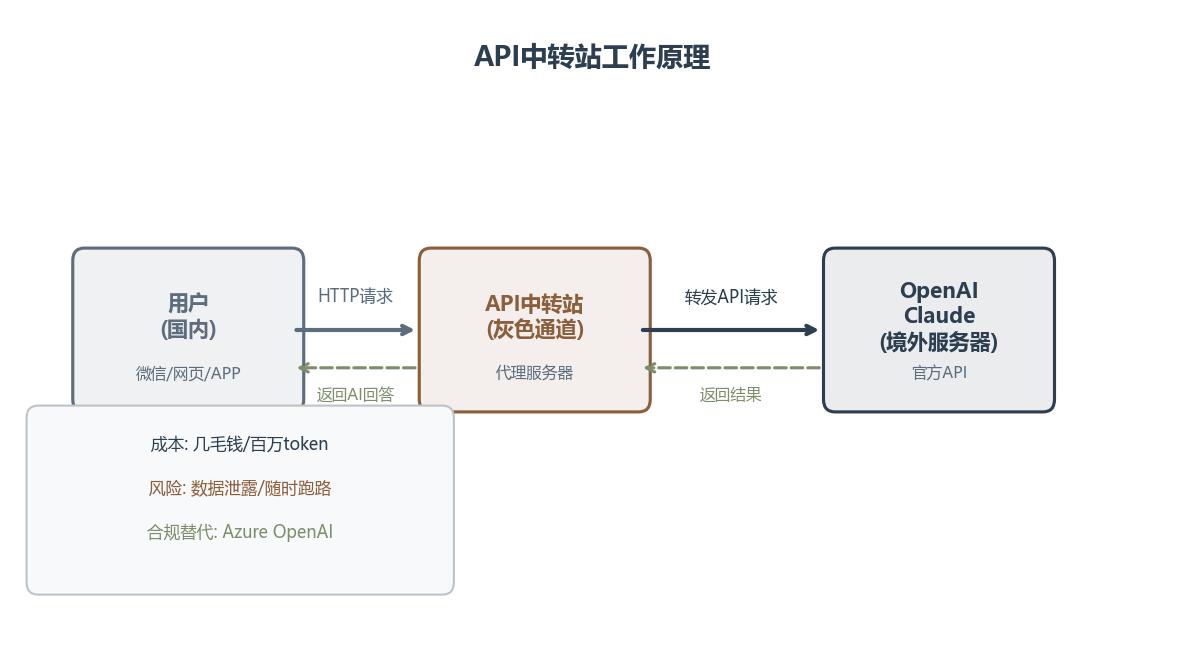
An API proxy station is essentially a “runner.”
These stations rent servers in the U.S., Singapore, or Japan that can directly access OpenAI’s official API. They then create an entry point in China (a website or app interface) where you can send messages. The proxy receives your message, forwards it to OpenAI, and then sends the response back to you.
The entire process requires no VPN, no software installation; you simply access the proxy’s website or app because its “domestic entry” is accessible from China.
The key point is that they use OpenAI’s official API, not a cracked version or web scraper, so the response quality is identical to that of the official site.
The pricing model is straightforward: pay per usage, with a few dozen yuan buying you millions of words. Payments can be made directly via WeChat or Alipay, making it extremely user-friendly for domestic users.
Top players in this field can generate millions of RMB in monthly revenue. At its peak in 2024, new users had to queue for an invitation code just to register.
Method 2: Mirror Sites, an Easier Entry
If the proxy station is a “runner,” then a mirror site is like “bringing ChatGPT into China.”
A mirror site is essentially a webpage that closely resembles the ChatGPT official site in interface and functionality. You can access it via a domestic URL without any special operations; just type and use it — the experience is indistinguishable from the original.
Technically, it’s simple: it’s built on top of the proxy station but with a ChatGPT-style interface. Every message you send on this webpage quietly calls OpenAI’s API in the background.
These sites typically earn revenue through membership fees or advertisements. Some are free but limit daily usage; others charge a monthly fee for unlimited access. They profit from the “information gap” — many users are unaware of the proxy option and pay for a “domestic ChatGPT” site instead.
However, mirror sites carry a hidden risk: What you think is ChatGPT is actually an unknown third-party site. No matter how similar the interface looks, the backend is not OpenAI. The operators can see your conversation history and account credentials. Some mirror sites even embed promotional links within AI responses.

A Complete Gray Industry Chain
These two types of services have formed a complete gray industry chain:
Bottom Layer → Middle Layer → Surface Layer
The bottom layer consists of technical providers who deploy API proxy servers abroad to solve issues like network latency and account security — they are the true tech experts in this chain. The middle layer consists of “resellers” who purchase API quotas in bulk from tech providers and sell them at a markup to end users, profiting from the price difference. The surface layer includes various community promoters, social media influencers, and sellers who package these services as “ChatGPT domestic version” or “AI assistant” and sell them.
A data point from 2025 estimates that there are over 5 million active users in China using GPT models through unofficial channels, generating over 1 billion RMB in annual revenue.
What Are the Risks?
In the gray area, risks are inherent. Proxy stations and mirror sites are fundamentally similar, differing only in entry points, and the risks are comparable.
First, data security. Every message you send can be seen by the operators. Proxy stations can see your queries, while mirror sites can directly access your entire conversation history. If you share confidential or private information, the risks are substantial — it’s akin to handing your business secrets to a roadside vendor.
Second, potential for sudden shutdowns. These services lack legal protections; a site could shut down overnight after you recharge, and you may not get your money back. Between 2024 and 2025, at least dozens of small service providers “disappeared.”
Third, policy risks. Although the current attitude towards individual use of AI tools is somewhat lenient, large-scale commercial operations of proxy and mirror sites could be subject to sudden crackdowns.
When Will Official Channels Arrive?
The good news is that this situation is changing in 2026.
Alibaba Cloud and Huawei Cloud have launched compliant overseas API access solutions that meet domestic regulations. Microsoft Azure’s OpenAI services have also been implemented in China through Century Interconnect. Although prices are higher than gray channels, they are legal, compliant, and secure.
In essence, gray channels are a temporary solution born from “demand first, supply later.” As compliant channels are established in China, the survival space for these gray services will naturally shrink.
Will you choose the cheaper but risky gray channels, or the more expensive but compliant official channels?
Comments
Discussion is powered by Giscus (GitHub Discussions). Add
repo,repoID,category, andcategoryIDunder[params.comments.giscus]inhugo.tomlusing the values from the Giscus setup tool.